
The Case for New Jersey
A conversation with DENSE founder Petia Morozov on the occasion of the Jersey Art Book Fair

I discovered DENSE shortly after moving to New Jersey. In fact the magazine’s first issue pretty much coincided with my move. Having just come from Berlin where the topic of design was ubiquitous, I found myself a little discombobulated living in the suburbs, and in New Jersey for that matter. Discovering a magazine that focused on design in New Jersey helped me feel a bit more grounded in my new surroundings. Fast forward a few years and I also discovered the Jersey Art Book Fair, an event hosted by DENSE that takes place at Mana Contemporary in Jersey City (an area that actually feels VERY Berlin).
On the occasion of JAB 2026, which takes place this coming weekend, I wanted to talk to Petia Morozov, the founder of both DENSE and JAB. An architect, designer and New Jersey native, Petia has spent much of her career making an intellectual case for a place that is often dismissed, derided and stereotyped.
Petia and I have corresponded periodically over the years and I was so pleased to meet her in person. I went in thinking I was interviewing a designer and the founder of a magazine and book fair, and came out feeling like I'd been given an entirely new way of seeing the place I’ve lived for the last five years. I honestly could have listened to her hold forth on New Jersey the entire day. Perhaps this is an occasion for a future Afield event?
AFIELD: Where did the idea for DENSE come from?
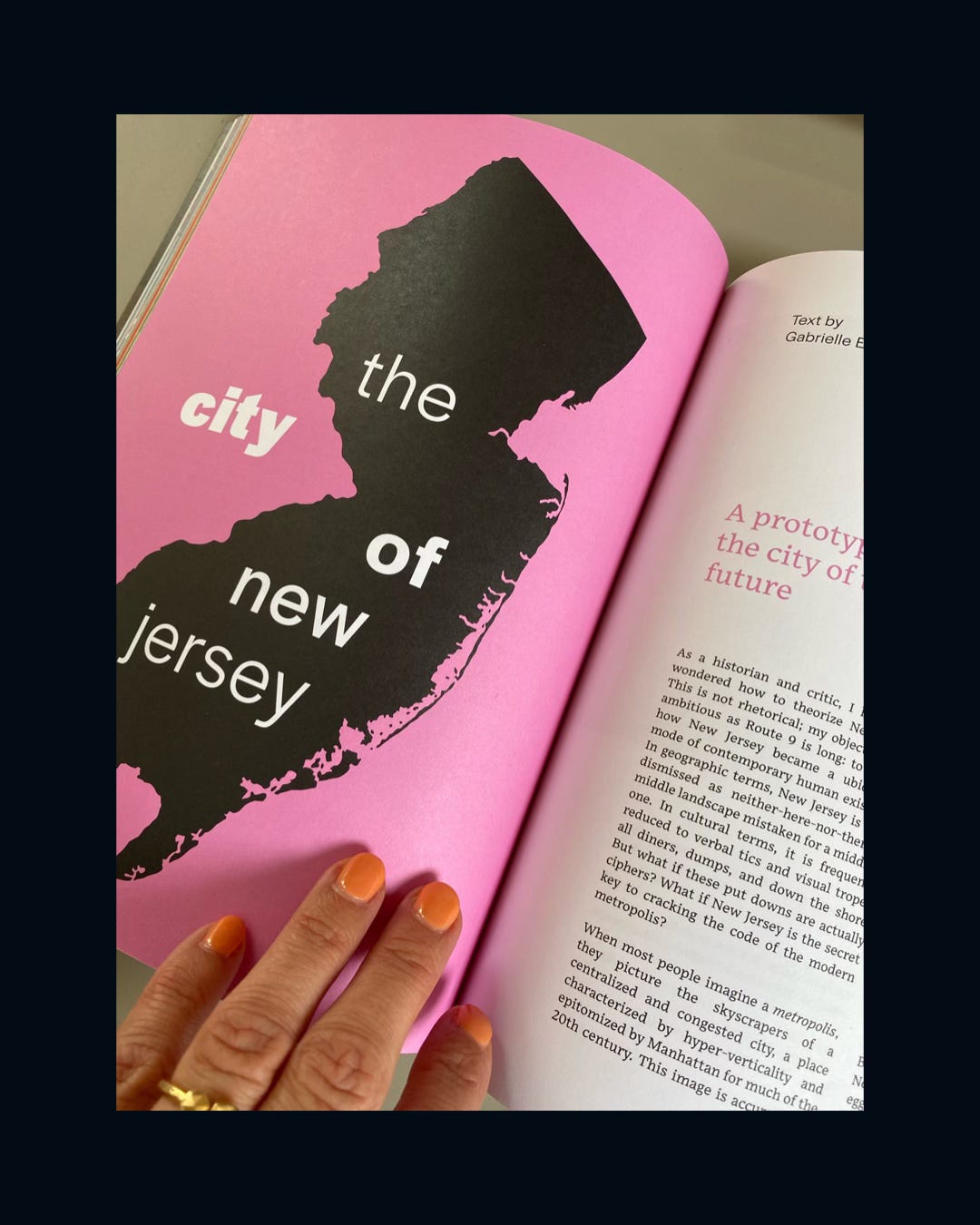
PETIA MOROZOV: From a frustration. The narratives about New Jersey were easy to digest but they lacked the depth and complexity of a place that is so uniquely positioned within the urban fabric of the eastern seaboard.
As a state we're close to 9 million people, and you feel the breadth of New Jersey's influence because of how New York really does share and blur its infrastructural needs: social infrastructure, transportation infrastructure, economic infrastructure. They are very blurred. As a Jersey girl, I was really trying to reckon my whole life with this question: why, if New Jersey is such an important place in the whole scheme of things, does it get so diminished by narratives that oversimplify this unique urban condition?
DENSE is one small pebble in that ripple, pushing back against the idea that the more dominant narratives get to win in a kind of survival-of-the-fittest storytelling. Place anchors all of the ways in which we represent our realities.
AFIELD: How does your design sensibility shape the way DENSE approaches storytelling about New Jersey?
PM: Design is always an act of speculation. You are conceiving of something that doesn't yet exist. There is a very thin line between the present and the future, which also means we are not so far from things that have happened in the past. DENSE is trying to seek some way to talk about New Jersey speculatively. We don't presume to have any answers, but as a question. And when we situate things in the past and think of them as having an archival quality, it makes it more difficult to imagine that there is still an act of reckoning required. DENSE is trying to change that.
AFIELD: You’ve described New Jersey as a “placeless place” with the repeating highways, the malls, the disorientation. And yet DENSE is entirely about making people see the place anew. How do you hold those two things together?
PM: You're talking about a place that is a total contradiction. Statistically very dense, and yet there is also a parallel narrative, one you don't so much read about as feel. There is a kind of placelessness, where forms of architecture repeat in ways that induce a placeless sensibility, that what you're doing in this town can be done in another town entirely.
But before New Jersey was New Jersey, it was a place of vast intelligence about how one engages and senses place. The geology of New Jersey, bounded by the Delaware and the Hudson, and more locally by the Raritan, the Hackensack, and the Passaic, the rivers have been storytellers of New Jersey and urban designers well before the Europeans arrived. And no one knows that story of place more than the Lenape, who cultivated this place to such an incredible level of innovation that we haven't given it the recognition it deserves. DENSE is trying to hold both of those things, the placelessness and the deep history, at the same time.
Operating away from the spotlight of New York or Philadelphia
allows for a different kind of thinking,
more lateral, more collaborative, more willingness to experiment.
AFIELD: A lot of people I know here have a complicated relationship with calling themselves suburban. Why do you think that is?
PM: New Jersey has always existed in relation to somewhere else. The state lines between New York City and Philadelphia are a formality. The infrastructural, social, and economic needs are so blurred that in many ways New Jersey is just the place where those two cities’ energy spills over. And for a long time, that has meant that most of our creative energy flows back to those two places rather than staying here.
But the idea of what the suburbs are is changing. New Jersey is going to fill in differently than New York or Philadelphia. Those were organized urban systems, intentional and legible. New Jersey is a series of accidents. And yet there is too much energy here for it not to grow into something. I would love for people to imagine what New York would look like if New Jersey vacated, not just physically, but creatively.
The complicated relationship people have with calling themselves suburban is also, I think, about not having a story that reflects back who they actually are. The dominant narratives about New Jersey, the jokes and the stereotypes are a way of not having to reckon with the place itself. DENSE is trying to give people another story. One that reflects the actual complexity and energy of where they live.
There are two factions of people.
You love to hate New Jersey or you hate to love it
(New York Metro area on your Linkedin is a dead giveaway)
AFIELD: You've described New Jersey as a place that operates out of the spotlight, away from the scrutiny of New York and Philadelphia. How does that obscurity become a creative advantage?
PM: New Jersey has an astonishing history of innovation, the offset printer was invented here, the film industry started in the Palisades, Fluxus was working in central Jersey, the first Black vocational school in the country was here. Utopian ideas flourished. Operating away from the spotlight of New York or Philadelphia allows for a different kind of thinking, more lateral, more collaborative, more willing to experiment.
AFIELD: Talk a bit more about Jersey Art Book Fair.
PM: JAB Fair is almost like a Trojan horse. It’s not about staking a flag and saying “now we have an art book fair.” It’s asking: could this act as a lightning rod for many more expressions of what New Jersey represents? A sense of place that I think of as hard to love. You love to hate it or you hate to love it. The “New York Metro Area” on your LinkedIn is a dead giveaway.
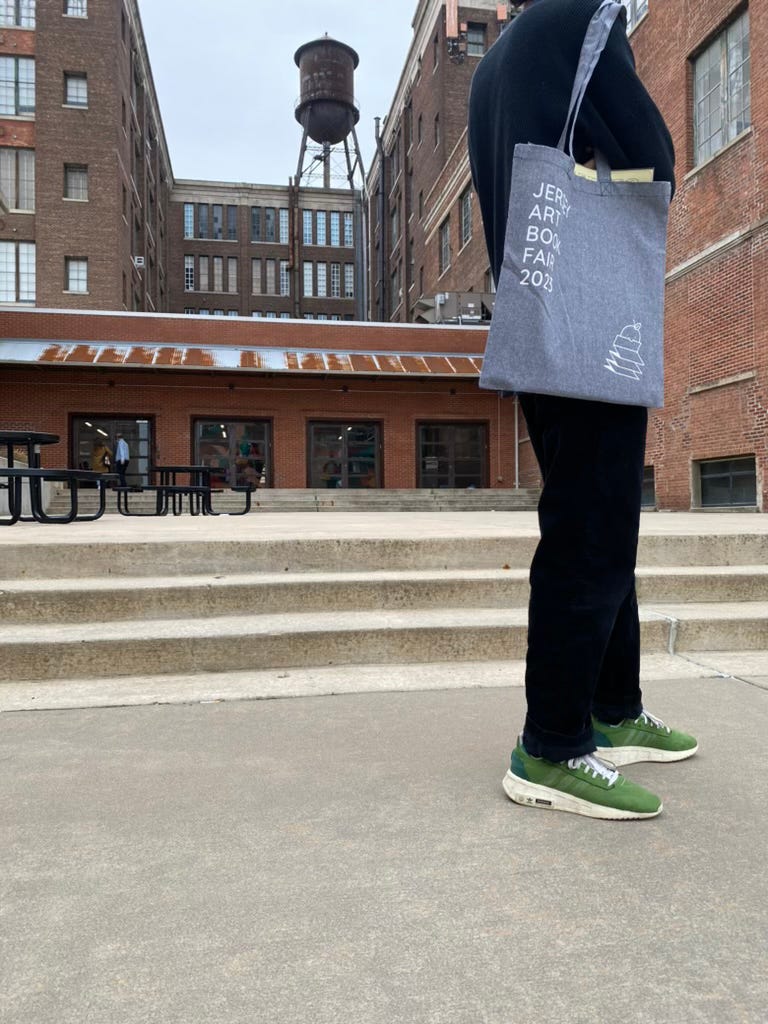
This year we’re focused on Journal Square and Mana Contemporary — which is itself a bastion of what Jersey City was. A tobacco processing factory that produced the cultural DNA that Mana is now capitalizing on. Jersey City is being threatened, like so many places, and that urgency is very present in this year’s fair.
AFIELD: What are some of the programming highlights at this year’s fair?
PM: Robert Sullivan, the acclaimed author of The Meadowlands, is leading a walk on Saturday morning, asking what it means to really inhabit and know a place. Saturday, May 2, 9am.
Alex Wolfe’s practice is about walking as a way of prompting questions about memory, loss, and what place induces in us emotionally. Sunday, May 3, 12:30pm.
Larissa Belcic of Nocturnal Medicine creates rituals around grief and climate change. There’s something very necessary about that right now. Ongoing.
Sue Huang, the current artist laureate at Rutgers, is performing an extraordinary piece through sound and image around botanical forms of life that have emerged in New Jersey and may no longer be part of it. Ongoing.
Rujuta Rao - Redraft (2026) is a spatial, modular publication, compact enough to travel, expansive enough to step into. At its center are complex infused beverages, alcoholic and not, that trace the artist's disorienting double life: one steeped in a childhood home in Goa, India; the other taking root in New Jersey. The two feel simultaneous, like the layered flavors of amaros and bitters which the viewers are invited to imbibe and contemplate. Each guest receives a limited-edition, risograph-printed menu. Saturday, May 2, 3:30pm.
Amanda Thackray and Jin Jung from Jersey City are leading a kite-making workshop. People will come together using found objects and things of personal meaning to make kites, and then fly them over Mana Contemporary as we close out the fair. Sunday, May 3, 3:30pm.
Jersey Art Book Fair takes place May 1-3 at Mana Contemporary, 888 Newark Avenue, Jersey City.
Another brilliant post Eileen!